The Origin of Tabla: Tracing the Journey of India’s Most Expressive Percussion Instrument

Among all Indian musical instruments, the tabla holds a special place for its emotional depth, precision, and unmistakable sound. Its language of bols, its expressive nature, and its cultural presence make it one of the most celebrated percussion instruments in the world.
But where did this remarkable instrument truly begin?
Contrary to some popular narratives, a growing body of scholars, musicians, and researchers point toward indigenous Indian origins, supported by archaeology, ancient texts, and evolutionary links with older Indian percussion instruments.
This article breaks down the authentic Indian roots of the tabla—without external or foreign-origin theories—presented with expert insights and a clear historical flow.
Understanding the Tabla
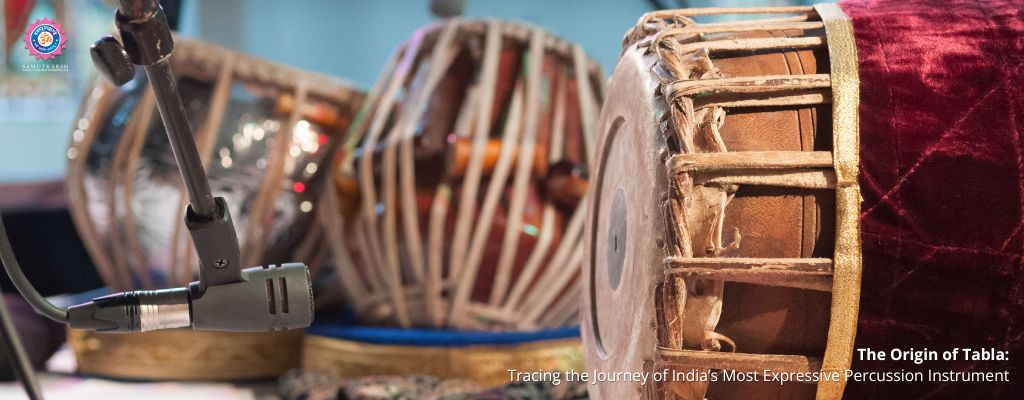
The tabla consists of two drums:
- The dayan (right drum), tuned to a specific note
- The bayan (left drum), creating deep bass resonance
Unlike many percussion instruments, the tabla allows melodic modulation, tonal shading, and a rich rhythmic vocabulary. Its bols—Na, Tin, Ta, Dhe, Dha—form a complete language of rhythm that musicians internalise over years of practice.
The Indian Origin of Tabla: Evidence, Evolution & Cultural Roots
The tabla’s development is best understood through three strong, India-centered historical paths.
1. Ancient Indian Sculptures Depicting Paired Drums
Various archaeological findings show that the concept of two hand-played drums existed in India long before the modern tabla.
Key evidence includes:
• Bhaja Caves (circa 200 BCE) – carvings of women playing a pair of small drums held in the lap.
• Ellora Temple carvings – musicians performing with drums resembling early forms of tabla.
• Badami cave sculptures – paired drums with clear visual similarity to split-hand percussion.
These artefacts indicate that the idea of dual percussion—one treble and one bass—has deep ancient Indian roots, long predating medieval periods.
2. Literary and Classical Text References
Classical Indian texts describe percussive techniques and drum forms remarkably similar to what we recognise today in tabla playing.
Important references include:
• The Nātya Śāstra (2nd century BCE – 2nd century CE) categorises drums, finger strokes, tonal modulation, and rhythmic syllables.
• Ancient treatises mention pushkara and dundubhi, drums played with varied strokes and complex taal structures.
• Early bol systems existed long before the tabla—proving the rhythmic language was already well developed.
These references show that the technical foundation of tabla—bols, taals, finger techniques—emerged in India’s classical tradition.
3. Evolution from the Pakhawaj and Other Indian Drums
The tabla is widely understood today as a natural evolution of older Indian percussion instruments, especially the pakhawaj.
Why the pakhawaj-to-tabla evolution makes sense:
• Pakhawaj players used complex bols similar to today’s tabla strokes.
• The need for sharper articulation and faster rhythmic clarity in emerging classical styles encouraged the development of a two-drum format.
• Splitting a barrel drum into two provided a treble drum (dayan) and a bass drum (bayan), allowing greater artistic range.
This evolutionary path is considered one of the strongest India-rooted explanations for tabla’s development.
Evolution Through Indian Gharanas
Once established, the tabla became part of India’s classical and folk traditions, forming gharanas—stylistic schools carrying unique philosophies and techniques.
Major gharanas include:
• Delhi – clarity, precision, and purity of bols
• Lucknow – graceful, delicate, expressive playing
• Ajrada – symmetrical patterns and intricate rhythmic logic
• Benaras – energetic, bold, and powerful strokes
• Farukhabad – balanced and lyrical style
• Punjab – influenced by older Indian drums like pakhawaj
Each gharana preserved India’s rhythmic heritage while innovating new compositions.
How Tabla Shaped Indian Music
Tabla transformed Indian musical performance. Its speed, articulation, and tonal versatility made it ideal for emerging Hindustani forms.
Today, tabla is a key part of:
• Hindustani classical music
• Kathak dance
• Bhakti and devotional music
• Ghazal and semi-classical genres
• Folk music
• Fusion, world music, and contemporary collaborations
Legends such as Ustad Zakir Hussain, Pandit Kishan Maharaj, and Pt. Anindo Chatterjee elevated tabla to global recognition—while maintaining its deep Indian roots.
Actionable Tips for Tabla Learners
• Master foundational bols – Na, Tin, Ta, Dhe form the backbone of all compositions.
• Focus on posture and hand placement – correct technique produces clear tones and prevents injury.
• Use a metronome or lehra app – timing discipline is crucial.
• Choose a gharana path – even modern learners benefit from structured lineage.
• Listen to great tabla maestros daily – absorbing subtle nuances accelerates learning.
People Also Ask – FAQs
Is tabla originally from India?
Yes. Archaeology, classical texts, and instrument evolution all point to an indigenous Indian origin.
Is tabla mentioned in ancient Indian texts?
While the exact term does not appear, the playing techniques, rhythmic syllables, and dual-drum concepts are found in ancient treatises like the Nātya Śāstra.
What instrument did tabla evolve from?
Musicologists strongly associate tabla’s evolution with Indian drums like the pakhawaj and pushkara.
Which is the oldest tabla gharana?
The Delhi Gharana is considered the earliest known gharana.
How old is the tabla?
The modern form is around 300–400 years old, but its foundational concepts are over 2,000 years old.
The tabla’s story is not one of foreign influence—it is a story of India’s own artistic evolution. From ancient carvings and classical texts to the transformation of traditional Indian drums, the tabla stands as a symbol of indigenous musical innovation. Its rhythms carry thousands of years of heritage, culture, and creative excellence.