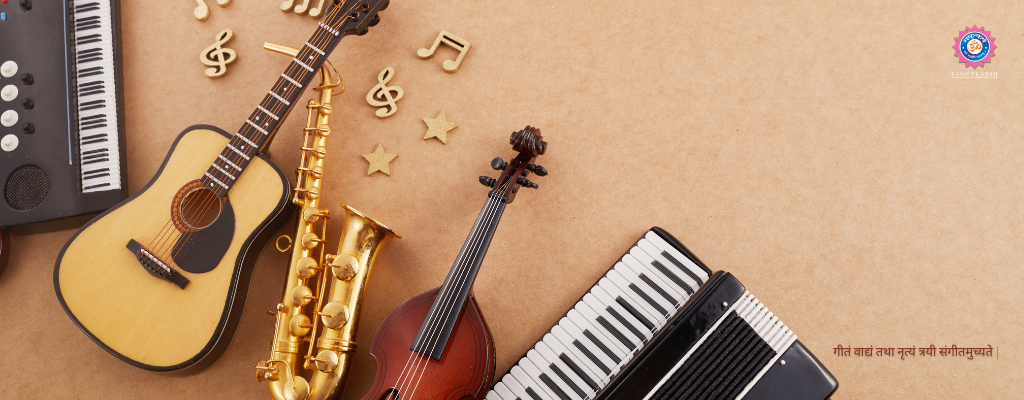
गीतं वाद्यं तथा नृत्यं त्रयी संगीतमुच्यते |

The three arts which include singing(गायन), playing(वादन) and dancing(नृत्य) are called music. Scholars have different views on when and how music originated. Music is our heritage, but musicology and music performance are the heritage of a musician.
Although there is a strong opinion that music started from the verses of Samveda. Therefore, music has evolved gradually from Samgyan to today. Many scholars, musicologists and great artists who perform music have given their best contribution in it. This is about the classical music of the upper class, but folk music is equally important in our country, because in India there are people from the general class to various tribes, who have their own music. In it (i.e. in folk music also) singing, playing and dancing are included, these three arts. In it too, folk music has evolved gradually from the Stone Age to today with some changes.
In any type of Indian music, notes and rhythm are the main elements. Various elements of music such as notes, rhythm, rasa, bhaav etc. have a deep impact on the human body and mind. Apart from humans, their positive effects are also seen on plants and animals.
All over the world music is for enjoyment. But in India apart from enjoyment music is also very useful for spiritual development and this is the specialty of our country.
Since ancient times in our mythology our gods and goddesses have been associated with musical ragas, instruments, dance etc. and later when the path of devotion came into existence music became extremely important for spiritual development.
As a result, top-class musicians nowadays often conduct research with God through music, and when they reach the climax of their presentation, they experience God’s presence. This type of music is also known as ‘Naadabrahma Upasana’.
In short, music in India is a source of enjoyment for the common people and a source of worship of Nadabrahma for the elite artists.
Auther – Dr. Mudrika Jani